
What’s Lurking in Your Half-Finished Masterpiece?

Do you have a chair in your studio? You know, that place for staring at half-finished paintings, wondering if you have what it takes to bring them to life. It’s not the blank canvas, but the ugly moments in the middle when everything feels wrong. That’s when the coercive voice of resistance whispers: “Give up, it’s no good, better to leave it unfinished”.

“Art begins with resistance—at the point where resistance is overcome. No human masterpiece has ever been created without great labor.” – André Gide

I’ve heard the whispering of resistance. When an idea feels bigger than me, bigger than I imagine I can be. When I question if I have any of what it takes to bring my vision to its fruition. And the answer feels like it’s going to be a hard “No”.

Yesterday I was only able to paint three brush strokes. The paint didn’t want to leave the brush. Each mark felt like a leap of faith, and the results weren’t ready to show themselves.

8paint Inspiration Friday What’s Lurking in Your Half-Finished Masterpiece?

Watching paint dry.


There are times to walk away. But there is also a time to keep working, even when it’s hard, when it feels unnatural, when we just don’t want to do it. The breakthroughs happen.

Pushing through the struggle has taught me that the best work often comes from those moments of discomfort. The richness of art doesn’t just live in the final product, it lives in the layers underneath.

We don’t create masterpieces by gliding through the easy parts. We create them by leaning into the unknown, stepping into the dark, and trusting that something beautiful is on the other side.
 

Can your best work emerge from discomfort?

How do you transform resistance into breakthroughs?

What’s lurking in your half-finished masterpiece?

What mountain are you ready to start moving?

Yesterday, the morning started off ugly. I stood overwhelmed and decaffeinated, staring down a pile of laundry that had somehow tripled in size overnight. It was still in the process of reproducing. Growing like a pile of insatiable rabbits.

“The man who moves a mountain begins by carrying away small stones.” – Confucius

When facing a mountain of clothes (or dishes or even emails) it’s easy to feel defeated before we even venture to begin.

This month, artists and students of art have bravely decided to sign-up and tackle the figure with me.

Ha ha ha ha ha ha ha ha ha ha.

At first, all of this learning can feel like a mountain, but with just one sketch or brushstroke, we’ve started the climb. And we’ll be there before we know it.

Art, like laundry, is a process of small steps. You can’t rush it. The trick isn’t to leap into mastery—it’s to break the mountain down into small stones (or folded tee-shirts). Overwhelm is easy. Instead, show up each day, make one drawing and then another, and suddenly and often without warning…progress.

8paint Inspiration Friday What mountain are you ready to start moving?

This is how we build masterpieces. One study at a time.


Satisfaction doesn’t come from seeing the top of your mountain, because in the case of my pile of laundry, the top of it may never be visible. It’s knowing that every brushstroke, every matched pair of socks, is getting you closer to a beautiful painting, or at least some clean undies.

So, the next time you’re faced with something that appears insurmountable, remember to break it down. The summit isn’t discovered by tackling it all at once. Each small success builds on the last, creating a foundation for much larger leaps down the road. Savor it! You’re closer than you realize.


Can consistency become a creative superpower?

Have your breakthroughs come from small rituals?

What mountain are you ready to start moving?

Where is the beauty in imperfection?

When was the last time you saw a figure not as a body but as an expression of emotion living in form?

“The artist must train not only his eye but also his soul.” – Wassily Kandinsky

Figure painting is more than anatomy; it’s about breathing in and then breathing out. Life through posture, color, light, and shadow. As artists, we can often find ourselves stuck muddling with proportions, but the real magic happens when we allow ourselves to paint not just what we can see but what is being felt.

Think of the works of Egon Schiele. His figures: raw, distorted, and imperfect—were alive with emotion. He didn’t merely paint bodies; he was painting in response to our human condition. Every line, every color spoke of vulnerability, strength, and the beauty of imperfection. Can we approach our own figure paintings in this way? Can we get out of the way and allow the figure to tell its own story through our brushstrokes?

8paint Inspiration Friday Where is the beauty in imperfection?

For Egon Schiele, the anatomy became a wordless story.


There’s a certain vulnerability in painting the figure. You’re not just drawing a person; you’re capturing their presence. It’s a dance between technique and intuition, between control and letting go. What if we let the figure and the paint itself guide us? What if we set aside perfection and instead, paint what feels true for us in that moment?

The next time you sit down (or stand, or lie on the floor) to paint the figure, let go of the idea of getting it “right.” Focus on the rhythm, the emotion, the story behind the pose. Capture not just what you see, but what you’re feeling, maybe even what you imagine your model to be feeling. Allow the figure to become more than just a body—create the space you need to have an experience. Create a painting.

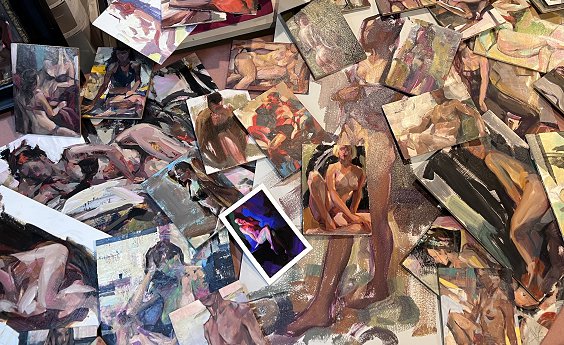
8paint Inspiration Fridays - Figure Paintings by Gabriel Mark Lipper

How can you express emotion through the human form?

What story is the figure telling in your work? Have you tried telling that story?

Where is the beauty in imperfection?