
Do your assumptions need glasses?

Seeing is believing. Unless you don’t happen to believe that. A lot of us get this one backward.  We see what we believe.

“The question is not what you look at, but what you see.” – Henry David Thoreau

A good portion of how I see comes from my beliefs about how the world works.  Sometimes this can be helpful, like when I decided that becoming an artist was a legit career move, but it can also be a major handicap, like when I think I know what my wife is going to say before she says it.  When I use experiences from my past (or even the experiences of others) to anticipate my probable future, it affects what I get to see.

One exercise that helps me to break this vicious cycle of assumption is to take a little time away from knowing everything.  Naomi is a huge fan.  I step momentarily away from my already-know-what’s-coming ego and… break out the sketchbook.  I have to shift from assumption to observation and allow my drawing to shape my experience.

The whole world is reduced to a series of positive and negative shapes.  Any preconceived notions about what those shapes are falls away as I begin to draw.  I’ll draw friends I’ve known for years only to discover that I am seeing them for the first time. Everything changes when we finally take a moment to sit down and really look.


8paint Inspiration Fridays Citrus Still Life

Still Life’s are great because we don’t care about getting a perfect likeness.

The act of drawing something is the act of falling in love with it. Slowing down, taking the time to observe the minutiae and sort out the shapes. It’s a different way of seeing.  Instead of judging, it’s almost like we’re guests in a new world, seeing everything fresh and for the first time.

The next time you’re drawing something, try drawing all of the shapes that surround your subject. Instead of trying to draw the eye and then the nose, what shape does the space between the eye and the nose make? Drawing from a photo? Turn it upside down and see if those shapes aren’t just a little bit more obvious when you don’t know what you’re looking at. This is a great way to let go of what we think we know and to take some steps closer to seeing the truth of what exists in front of us.

How often do you notice assumptions in your work?

How do you move beyond your assumptions?

Do your assumptions need glasses?

How can a painting talk?

This is my 100th Inspiration Friday! Thanks for reading and joining in!

“You might as well ask an artist to explain his art, or ask a poet to explain his poem. It defeats the purpose. The meaning is only clear through the search.” – Rick Riordan

Standing in front of a painting by Gauguin, I’m transported. His work takes me out of the d’Orsay and drops me off in the state of Wonder, leaving me stranded, with a bag lunch and bus fare. Lost, somewhere between flatness and form, color and light.

Maybe you can help me to decipher the rich meaning and spirit embodied in his art. Gauguin fell in love with ideas his words failed to describe, so he painted them. The canvas gave him permission and a voice. Sometimes what surfaced wasn’t particularly comfortable or even welcome. His paintings found their form in chaos, abstraction, and those parts of him that lived both selfishly and universally.

Life holds a bit of everything. Love and kindness, fear and hate. The best work holds all of these dichotomies up for us to see without taking a side or choosing a team.

Some of my best paintings hang happily on my walls at home, while others have been damned to a life of purgatory in the storage racks above my studio. This half-life may be enough for me, but the paintings are restless. They long to speak, and be spoken about. That’s hard for me sometimes because I hear their murmuring, and wonder if there’s anything to be done about it. They ask to be painted over and given a new voice, to live again on a stranger’s wall, or at least, to be given a proper burial.

Great paintings are reborn in the presence of the viewer. This second life begins not on the artist’s easel, but on the walls of our homes, galleries, and museums. Now, they reflect an opinion. They’re being seen.

They speak to you using irony, sorrow, birth, laughter, war, beauty, or maybe even grace. All of these things emerge from the viewer’s willingness to see and engage. It’s our response to the work that gives art its longevity.


Inspiration Friday - How can a painting talk? (Arearea - Paul Gauguin - 1892)

Arearea – Paul Gauguin – 1892

When you make the decision to create, and then follow through with that decision, and begin, you have entered the ring. You are in the game. The more you are willing to give to the game, the richer that game will be.

Your commitment and determination imbue your paintings with the charge that holds the viewer captive. (Some paintings are so infused with the artist’s passion that it becomes almost impossible to escape or even look away.)  But the outcome of this great enterprise is never yours to determine. That can only be discovered once you’ve done your bit and then let it go.  Offering your work up to the world so that it may be seen.

For the beginner, the focus should only be on making art. Imaging who might see your work or where it will eventually end up is a perfect recipe for overwhelm. It leads to inaction and overthinking. Just make your paintings.

The act of painting isn’t for anyone else but you. It gives you peace and purpose, it’s thrilling, and at times, painful. Painting is its own reward. We simultaneously create and receive.

At the end of the day, after you’ve played your part, something shifts. Unless you keep them locked away, your paintings are no longer yours alone. They have something to say beyond what you’ve intended. So send them off into the world with your blessing. Sharing your excitement for what you’ve created is inspiring and welcome.

We don’t need to see another masterpiece to be touched by the power of art. But we do need to be reminded that new art is being made. Beauty continues to show up in all of its mystery. Art speaks ineffably, in a language without words, so each of us might take a moment to discover the meaning for ourselves.

Have you ever asked a painting what it means?

Can a painting change your mind?

What’s the difference between painting and looking?

How can a painting talk?

Does creativity need a treat?

March generally arrives on momentum and fumes, and down-shifting from full speed doesn’t always come without grinding a few gears. The paints are out, the panels are ready, but my head is still spinning.

“Beauty is not caused. It is.” – Emily Dickinson

We are well into the first part of the Learning To See course, and all of the hard work and creativity I’m witnessing is inspiring. The enthusiasm this year is next level. I’m ready to jump in too, but instead, I’m going to focus on slowing down and taking it all in.

Inspiration doesn’t respond well to demands. She lets our messages go straight to voicemail and checks in on them as her schedule permits.


8paint Inspiration Fridays

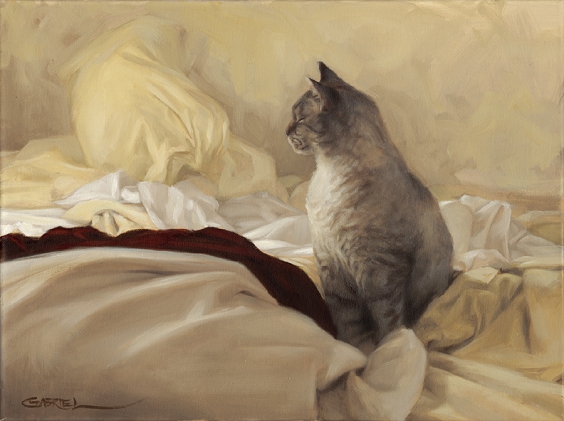
“Theo” – 18″ x 24″- oil on canvas- Gabriel Mark Lipper

Creativity is a cat. She chooses you. In the meantime, all you need to do is show up and be ready to let her in. But don’t worry, she’s coming. She may tease you standing at the open door or darting away when you call, but eventually, she’ll come in, and begin purring in your lap. That’s the best.

This shift from fast to slow takes time. My March and April have become the time for the germination of ideas and not necessarily for final results, and that took me a while to learn too.

So I make room, I get ready. I begin with old photos, that charge up my memories, and remind me of the stories I like to share. I make little sketches. I listen and observe. And eventually (and inevitability) the muse returns.

I’ll be here with a warm saucer of milk.

Do you slow down enough to create?

Are you comfortable with not knowing?

Does creativity need a treat?