Can you create with what you have?

Each morning I explode out of bed like Evel Knievel with the belief that anything is possible. I’ve yet to be proven wrong, though, on occasion, I’ve misjudged the timeline and the distance.

“To be an artist is to believe in life.” – Henry Moore

At breakfast, I still believe anything’s possible. That’s because I’m an artist (and I don’t watch the news). I look forward to the start of every day. After a hearty bowl of oatmeal with raisins, I’m ready to jump fourteen Greyhound buses.  I’m never more alive than when I’m flying past my limitations. The act of creating is like guzzling Redbulls face-to-face with your new lover while riding a wheelie into an apocalyptic sunset.  It’s scary. It’s beautiful. It’s epic. That’s the 750cc air-cooled V-twin that drives me. The real success of an artist can only be defined by the love of what they are doing..
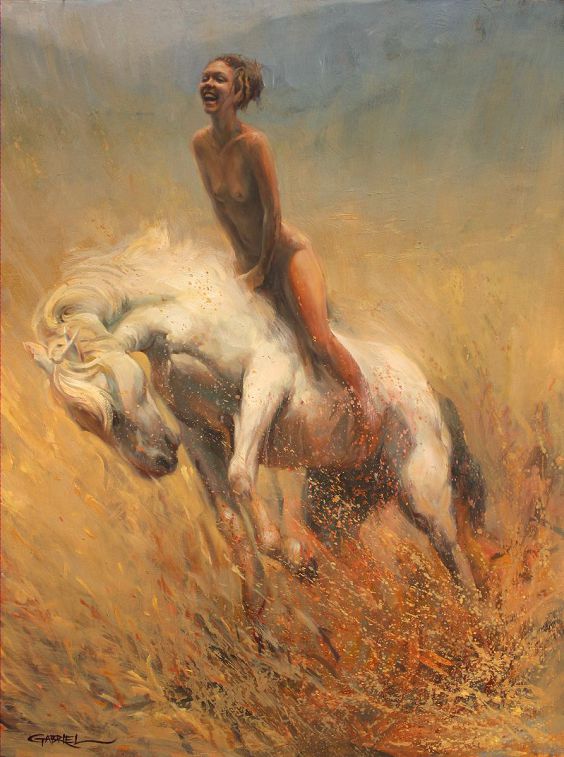
That’s a lot of horse-power.

For many of us, becoming an artist isn’t an intentional career move. Starting out, I wasn’t too focused on the career aspect. I started painting to get the ideas out of my head and it evolved into “fine art”. Some of my friends started painting to put something up on their walls, and then that evolved into “fine art”. Art is not about how much you can get, it’s about how much you can create with what you have. It’s an important distinction. Art is about asking the question “what is possible?“ And then, it’s about answering that question again, and again, and again in new ways with different answers.

Art is really about the act of feeling alive. Everything is art when you approach it with passion. Some artists are passionate about sales. Some artists are passionate about color. For others, it’s all about expression. Passion shows up as a meditation, it shows up in community and solitude. We are all unique in what we love. This is an image of art at its most luminous. A scratch-n-sniff rainbow of possibility. But I’m well aware that it’s not all rainbows and motorcycles.

This is where it gets hairy. You can believe, devoutly in your art, and in the creative process, but somedays you get sludge. Your colors are mud and your bike doesn’t clear the bus. Your love for what you are doing can begin to feel like quicksand. I have found myself teetering on the edge of that abyss quite a few times and it doesn’t feel good. It can feel a little dysfunctional.

But it also feels like life. Unpredictable, and ever-changing. And I love my life. Art is about discovery, innovation, rejection and frustration. It’s the whole package. So when we step into the studio and begin to paint, instead of looking for solutions in certainties, let’s make discoveries and open up possibilities. The solutions will come, but creativity is about risk and challenging ourselves to stick with it, even when it’s uncomfortable. Go for that 15th bus. You’re going to nail it.

When did your art make you feel uncomfortable?

When did your art make you feel alive?

What’s the biggest risk you’ve taken with your art?
 

What can your art teach you?

When chatting with new and even mid-career artists, one of the most common questions I’m asked is “How do I find my style?“ I think maybe the question needs to be reframed… “How do I find myself in my art?“

“Art enables us to find ourselves and lose ourselves at the same time.” – Thomas Merton

I didn’t start painting because I was looking for a gig or an identity. Art is my teacher. Every day that my eyes are open, I learn through the work that I choose to create.

The journey started off in a state of play (most journeys do). Drawing ideas, and images from my head I began creating worlds from my imagination. It also served as a tool to help sort out some of life’s confusion. My art taught me to play and to think.

When I began to focus on art more seriously and realized I was going to make it my career, part of me shrank back from that play. Putting myself and my art out into the world was scary. My work grew tighter and more realistic. I worked hard. My art taught me that I was careful.

I wanted people to be able to relate to what I was creating, and I wanted to prove to them that I was talented. Everything from the subject matter I chose to the realistic way I chose to paint reflected my need for external recognition and approval.

It worked. My work was relatable to many, and it sold. I learned that I could conform.

I kept painting, but soon tired of trying to reproduce the world around me correctly and accurately. I wanted to express more than what I saw in front of me. I learned from my art that I am impatient with limitations.

Inspiration Fridays What can your art teach you?

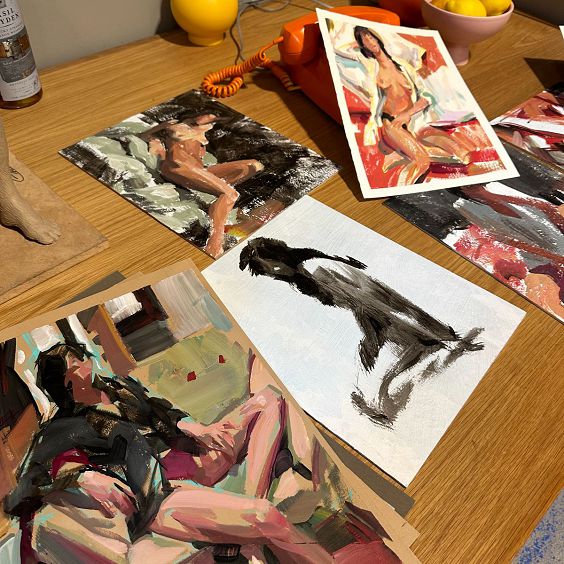
Even if I only have time for a few sketches, I know that I have to create.

I began designing narratives that illustrated how I viewed the world. Detached partygoers, distant nudes, elite equestrians, burning worlds. I learned from my art that I was cynical.

When my child was born, something shifted inside of me. I began to deconstruct the elements in my paintings.  Breaking edges, letting go of details, focusing on the big picture, and allowing my work to be misunderstood. I learned from my art that I could be vulnerable.

But instead of asking those horrible questions…“what is it?” and “are you done?” People began asking me “How did you do it? How did you find your style?” I learned that my art can help others find their art.

Your style has always been there. Your style is you. When you’re ready for more, your style shifts. When you’re hungry to discover something new, you get to lean in, learn, and your style grows as you grow.

Your art helps you discover who you are and it will sustain you. Your art is worth doing.

What have you learned about yourself through your art?

What clues does your style give you about who you are?

Who does your art say that you are?

Squint To See Clearly

I was a junior in high school when I was told by the optometrist, that I needed glasses. It was the first in a series of blows to my youthful invincibility. I lost them within a week along with my fifth set of house keys on the back of the #8 TriMet bus. Unlike the keys, the glasses were never replaced.

“The artist sees what is there and not there.” – Tony Follari

My paintings haven’t suffered from the loss of my glasses. In fact, there is a technique commonly used by us painters called “squinting down“. When you want to see the big shapes, and differences in values more clearly, you squint your eyes to get rid of the details. This gives you a much more solid sense of your forms and the overall composition.

Painting played a huge role in restoring my 2020 vision. One of the exercises commonly prescribed to strengthen your eyes is to look at something near you, and then look out as far as you can into the distance and back again. This is what an artist does. We look out into the world and then back again. Whether we’re looking at a landscape or a model, our eyes are constantly refocusing and reevaluating the world in front of us.

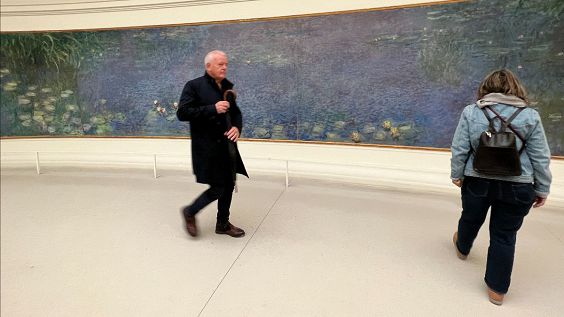
Monet's Water Lilies

Monet’s Water Lilies are displayed in a figure-8. He designed the display rooms and donated the work to the French state as a symbol of peace. It was installed months after his death in 1927.

I had the opportunity to see Monet’s Water Lilies in person at the Orangerie Museum in Paris last fall.  Monet developed cataracts during the last 20 years of his life, but it didn’t slow his passion for paint. In fact, his later works tended to be bolder with more vibrancy and color. He was less concerned with the details, and instead, obsessed over the quality of the atmosphere, that his paintings conveyed.  “I’m going blind, and that’s too bad, really too bad. But on the other hand, how fortunate to be forced to look at nothing but heaven.”

I’ve known several painters whose paintings improved when they took their glasses off. Each of our perspectives is completely unique. The way that we see the world is unlike anybody else. That is our gift.  Share your vision.

How is your painting changing?

What is it about the way you see the world that is different from anyone else?

Where are your blind spots?