Inspiration Fridays! Are your eyes playing tricks on you?
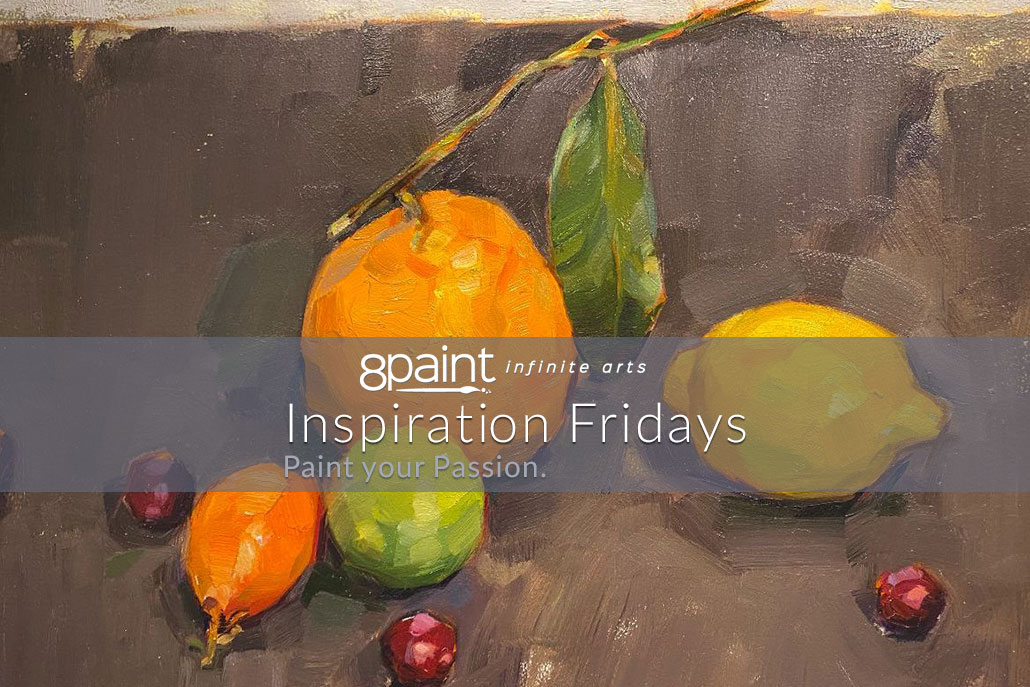
Are your eyes playing tricks on you?
Seeing is more than just using our eyes. It’s about interpretation, understanding, and the stories we tell ourselves about what’s in front of us.
“The question is not what you look at, but what you see.” – Henry David Thoreau
Two people can look at the same landscape, the same model, the same light falling across a still life, and walk away with completely different experiences.
As artists, our job isn’t simply to record what’s in front of us, where is the artist in that? We’re here to breath in the world and respond with our own voice. That’s the assignment, but that doesn’t make it an easy one. Our minds want shortcuts, we want to name things (eye, nose, tree, shadow) and move on. We assume shadows are black and trees are green. But shadows shimmer with color, and trees hold every shade from lavender to ochre.
When our paintings are based on shorthanded assumptions, the work becomes generic and sterile. But when we truly observe, and respond with authenticity, our work has life. Life comes with empathy, it comes with frustration and fear. It’s charged with passion, love, and many other ineffable truths. For most of us, those truths aren’t easy to express and that’s why we get to paint.
One exercise that helps me to escape the lure of assumption is to break out the sketchbook. The whole world is reduced to a series of positive and negative shapes. Any preconceived notions about what those shapes are falls away as I begin to draw. Slowing down, taking the time to observe and sift through the details and minutiae to reveal the essence of what’s I’m front of me. It’s a different way of seeing. I have to shift from assumption to observation and allow my drawing to shape my experience.

Still Life’s are great because we don’t care about getting a perfect likeness.
The next time you’re drawing something, try drawing all of the shapes that surround your subject. Instead of trying to draw the eye and then the nose, what shape does the space between the eye and the nose make? Drawing from a photo? Turn it upside down and see if those shapes aren’t just a little bit more obvious when you don’t know what you’re looking at. This is a great way to let go of what we think we know and to take some steps closer to seeing the truth of what exists in front of us.
How often do you notice assumptions in your work?
How do you move beyond your assumptions?
Do your assumptions need glasses?