What does your artwork say about you?

Last week I was asked if I ever painted paintings just because I thought they would sell. And I have to admit, that, especially when I was broke, I did everything I could to anticipate what the market might want. I wanted to survive as an artist and that wasn’t easy. I hadn’t even begun to grasp the vastness of that divide that lives between being a painter, and the marketing of a painting.

“The role of the artist is exactly the same as the role of the lover. If I love you, I have to make you conscious of the things you don’t see.” – James Baldwin

But reaching the market wasn’t why I started painting. It’s also not why I continued to paint when even being a painter seemed like a fool’s journey.

I paint because it’s my way of making sense of the world that I live in. With paint, I can say what I think about the world, and those thoughts are reflected back at me in visual form.

When my paintings are honest, I get to learn about my truth. When they’re superficial, motivated by insecurity, or the need for validation, I end up learning even more about myself.

Lilies #4 - acrylic on panel - Gabriel Mark Lipper

Lilies #4 – acrylic on panel – Gabriel Mark Lipper

How many times in life have we tried to anticipate what someone is going to want only to discover that we have no idea? We can end up sanding down the parts of us we feel might stick out too much, with the hope of fitting into another person‘s mold.

When we put our real selves out there and risk, our risk resonates. Our risk even resonates with people who haven’t had the courage to try. It resonates with people who have failed, and it resonates with everyone who has ever had a crazy idea, and chased it.

And this is the job of an artist. We are here to share what we see. An artists’ perception is an authentic reflection of both the internal and external experience of life. That’s why making good art is so hard. We are addressing the business of living, and life isn’t a product.

So the next time that you’re standing in front of your easel, don’t bother trying to discover what’s trending, or what the market is looking for. But do be intentional. If you are still at the beginning of your artistic journey, show us your struggle. Don’t try to cover it up being slick or careful. Give us your best, and if it’s clumsy or fragile, it will be all the more beautiful for it.

Show us your process. If you’ve already logged your 10,000 hours, make sure you’re leaning in and forcing yourself to go deeper. It would be a shame to waste your mastery on something easy and redundant.

Art is sacred because it can show us what we haven’t been able to see. That’s where its value comes from.

Are you painting what you love?

If your paintings could talk, what would they say?

What does your artwork say about you?


Are you stopping before your start?

Have you ever been too scared to move?

“I just literally made what I couldn’t do and that became my visual language.” – Jenny Saville

As I looked down at the glassy flatness of the lake and the sheer cliffs of the cove, the little circling motor boat and chanting people below looked like toys. Back to the top of the cliff. My friends stood around me at full size, cheering me forward: “Just jump!

Most of my formative teen years were spent in Portland, Oregon attending Lincoln high school. It’s the same school that Mark Rothko graduated from in 1921 and later Matt Groening scribbled his way through in 1972. I don’t have a plaque yet, but I hope I’m on the shortlist. The school is located in the heart of downtown Portland. There are a lot of tall buildings and buses, but no cliffs or lakes.

There was no getting around the inevitable. My best friend had already jumped twice. Everything in my body said no. But at 15, I was hardly in my body. And so, after what could have been 5 full minutes of standing there wondering if I would ever recover a chance with any of the girls who were witnessing my cowardice, I took a breath, and I jumped.

Terror was replaced by weightlessness, wind, and endorphins. I was flying. The cliffs and little shrubs careened by. The chanting onlookers and party-boat were life-size. Then the water with its icy bite. Even that sensation was replaced with a tingling sort of ecstasy. I scrambled to the surface of the lake, gasping for air, refreshed, and most importantly, redeemed. It felt good.

Do you know what part of that memory sticks out most? The waiting. The second guessing. The self doubt. It was a big leap, and I didn’t think that I was ready, but it turned out that I was.

Too High - oil on canvas - Gabriel Mark Lipper

Too High – oil on canvas – Gabriel Mark Lipper

How many times have we stopped before we even get started? Staring at a blank canvas wondering if our ideas are good enough, if we’re talented enough, if we even have the right supplies? Or even halfway through, when we get to the ugly stage and stop. In that moment, it’s easy to believe that this is all that we can do, and that we have failed. And sometimes, if we let it, that feeling can live with us. It can stop us from ever starting. It can keep us from showing up to the studio at all.

But then, all it takes is picking up a brush. dipping it in the paint, and taking the leap. We are flying. Painting isn’t hard. Thinking about painting is hard. Waiting for inspiration is hard. Beating ourselves up because we’re not ready is hard.

So the next time you think about how you should do more drawing, or you really need to get back in the studio, take that moment to put out your sketchbook and get your paints ready. Take the leap. It’s the waiting that hurts. The doing feels amazing.

Do you have to wait until you’re ready?

What feels like jumping?

Are you stopping before you start?


Have you let your art lead?

Have you ever made paintings based on how you see things? It feels amazing to get it out on the canvas. Sometimes people might even resonate with what you’re putting down. They’re your people.

“The purpose of art is to lay bare the questions that have been concealed by the answers.” – James Baldwin

A good portion of my early career was spent creating art that was an expression of how I felt. I’m sure to a great extent the art I create now is the same, but the emphasis has shifted along the way. I am more interested in inviting others into the process. I’d rather know how you feel when you look at a painting. I want my painting to provide a dialogue instead of a monologue.

When I was younger, I was appalled by how few people understood what was going on in this world. Now I know that I am included in this lack of understanding. It helps with my cynicism. Most of my early answers came from assumptions I had made about how things work and who people are. Relying on this cognitive bias to navigate life kept me stuck in familiar patterns and safe loops. It made my world small.

Good and bad were easy to define, and this kind of binary thinking made life a bit simpler to navigate. But it didn’t help my art. People could appreciate my clarity, but there was no room in the work for them to engage. No place for them to get lost, or meditate on what could be.


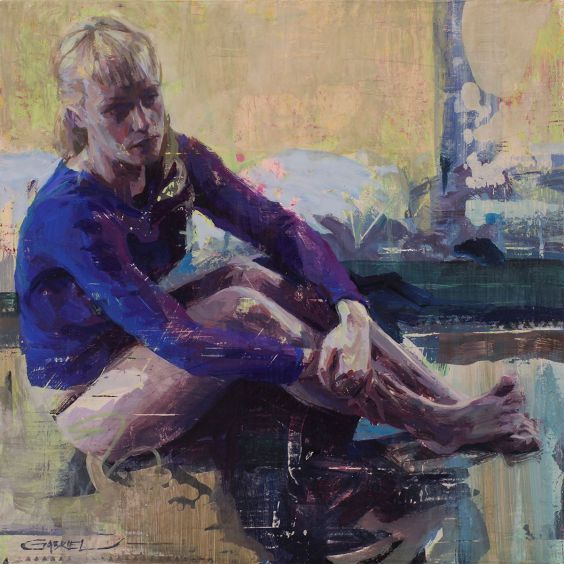
Reflection in Blue - 18"x18" - mixed media on panel - Gabriel Mark Lipper

Reflection in Blue – 18″x18″ – mixed media on panel – Gabriel Mark Lipper

My assumptions about the shapes of things, the colors of things, and the nature of things were closing down the artistic conversation. Then, I began breaking edges, leaving parts of the painting unfinished, or allowing other parts of my process to show through. My art began to ask questions instead of giving answers. It asks me questions.

Good art leaves the door open for new ideas, replacing the pursuit of mastery with the love of wonder. I am in love with the process of learning to see. And learning what my art has to teach me.

.

Does your art make statements?

Does your art ask you questions?

Have you let your art lead?