
Who do you paint for?

We all start from nothing. The swagger in a man’s eyes and the sway of a woman’s hips are enough to build both fortune, and rain ruin.

“The greatest masterpieces were once only pigments on a palette.” – Henry Hoskins

When I started off on this painter’s journey, I believed in overnight success. I anticipated some hard work but honestly, I didn’t expect my rise toward immortal stardom to take very long.  The self-proclaimed best artist in third grade, I held tightly to the belief that fame and world domination were eminent. My 25th birthday came and went without any fanfare, and through bloodshot eyes, I saw that the cloudy door to my fantasy of being a celebrated child prodigy and 20-year-old superstar had closed.  It seems funny to me now, but at the time I was devastated.  My imagined and fictitious bubble of success had burst, and I felt like I had blown it.

Twenty-five was actually the first year that I managed to work full-time as an artist, without washing dishes, serving espresso, or waiting tables.  It was a big year for me, I just couldn’t see it.  I had been chasing the unattainable.  There would be no Doogie Howser M.F.A.  The bar I had set for myself didn’t even exist.
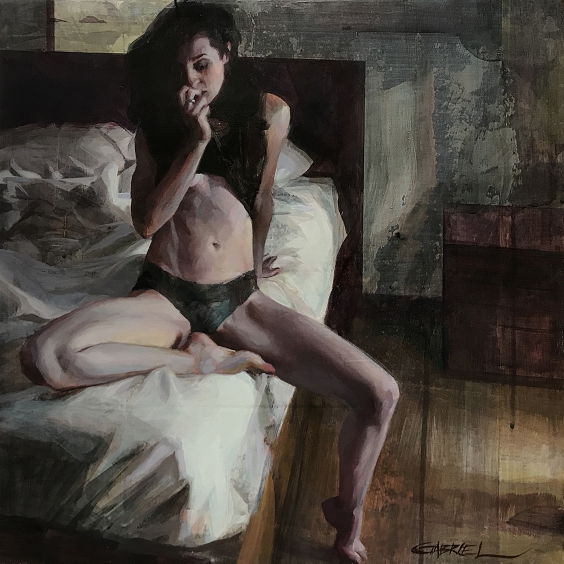
Insomnia 5am - Mixed media on panel

Insomnia 5am – mixed media on panel

Comparisons are odious, but it can be difficult to keep our perspective in a world inundated with social media blasts from people who live life as a brand.  The image of personal success is now being produced as entertainment.  That’s a lot to live up to, and it really doesn’t leave much room for creativity. It’s become even easier to fixate on our shortcomings, but what we really need, is a change in perspective.

What some may consider a lack of ability, creativity, or even skill, can be the very thing that makes our work decidedly unique. As long as we continue to show up for ourselves and feed our passion, we are in the right place.

Get back to basics. Why did you start painting in the first place? What did you love about it? Instead of painting what might be trending, or shooting for likes, create what YOU would like to see, or maybe even paint how you’re feeling.  This is the surest way to find your flow.  When we allow ourselves to be inspired and nurtured by our art, we will begin painting the work that matters.  That is the work that is uniquely your own.  Your work may end up in a museum or it may not, but authentic painting is always a gift to those who have the opportunity to see it.
How do you know if your paintings are any good? Why does it matter?

Why did you start painting?

Who are you painting for?

Does your art talk?

We’re all in this hot tub together, but how would you paint the water?

“Painting is just another way of keeping a diary” – Pablo Picasso

I like to paint the world around me, but it’s not necessarily the world that other people see. I might borrow inspiration from a life that I want to live or even one that I’m afraid of living. Sometimes I paint the hope I have for a life I haven’t experienced yet.  But the best paintings I’ve done by far, are the paintings inspired by the world in front of me.​  The world of now.  I like paintings that tell the stories that we don’t have words for.

I love abstraction, but completely abstract work can begin to feel a little cerebral when I’m painting.  There’s no narrative and no metaphor.  Combinations of shapes and colors can be beautiful. In fact, most of the paintings on my walls at home are abstract but when it comes to my own work, there are stories that I want to tell.  Digging through my psyche can unearth parts of me that I’d rather stay buried, but I’ve also discovered some real gems that I didn’t know existed.  Painting teaches me about myself.

These subconscious bones end up splayed out all over the canvas and help to show me who I am.  If not right away, at least they help to clarify who I was when I was painting them.

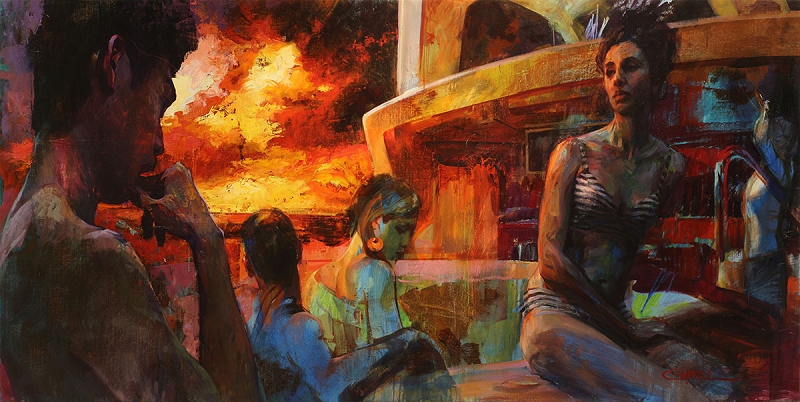
Gabriel Lipper - Birth of Athena

Birth of Athena – 48″ x 96″ – Mixed Media on Linen

Paintings allow us to gather elements and ideas in our minds and re-order them in a way that relates specifically to us. A painting is a gateway.  We are creating a new world for others to see.  There is no wrong interpretation. That’s what makes visual storytelling so brilliant. The viewer creates meaning around what they see.

How does the addition of an element or character change the narrative? The possibilities are infinite. Even the placement and scale of the subjects in a painting play a role in what the viewer gets to take away.  A flower in a vase might feel very different from a flower in a vase with one or two of its petals laying on the ground nearby.  This is a big part of what can make painting exciting.  It’s like creating a puzzle or writing a visual novel.

Try experimenting with unusual combinations of characters from old sketches and photos.  What would these two look like together? How would the story change If they found themselves in a different location?  Rooting through magazines or pulling from movies for compositional ideas is a great way to get the ball rolling.  Print out some of your photos and stick them to the wall.  Nothing is off-limits when it comes to telling your story.

How do you tell a visual story? Have you ever learned something about yourself through your paintings?

What would you like your paintings to say?

Do your paintings talk?

Creativity Never Sleeps

Sometimes it takes loosing some sleep to find myself.

“A dreamer is one who can only find his way by moonlight, and his punishment is that he sees the dawn before the rest of the world.” – Oscar Wilde

I’ve made 3AM my friend. It’s taken some time, and admittedly we didn’t hit it off right away, but creativity evidently doesn’t sleep and so, neither do I. For me, insomnia seems to be cyclical. Whether it’s the waxing and waning of the moon or the shifting of the seasons, I find myself awake at all hours of the day and night. Melatonin and valerian root aren’t cutting it. Even coffee is out for the most part. I just need a nap.

Naps are elusive at best and most of the time they are just fiction, so I bumble through the day and paint my dreams. But when the night returns and I still can’t sleep, I’m learning to embrace it. My wife, Naomi needs her sleep too, and so rather than tossing and turning until even the cat leaves, I’ve been grabbing a sketchbook and tip-toeing downstairs.

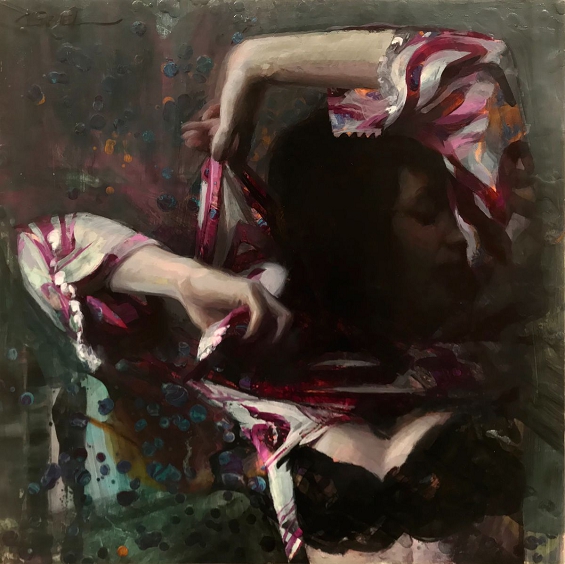
Gabriel Lipper - Insomnia 11pm

Insomnia 11pm – 18″ x 18″ – Mixed Media on Panel

My studio is just a mile away so if I’m feeling particularly angsty, I’ll throw on some clothes and go big. This is the time of night that doesn’t count. It’s a great time to clean and organize or experiment with a new direction for my paintings. I don’t try to accomplish anything specific, that’s more of a daytime activity. The night is more about going down rabbit holes and checking things off the list.

If I feel there’s a chance I might find my way back to bed, a bathrobe and slippers are uniform enough. The couch becomes my studio. Five-minute sketches, or scribbled little figure studies are meditative and hypnotizing. Sleepytime tea and a number 2 pencil make wonderful night-time companions. It doesn’t take much, but I try to have some sort of art supplies available to me at every turn. There are sketchbooks stashed in both cars, at the studio, in my office and garage, and one on the nightstand next to my bed. I have learned the importance of making access to creativity easy.

The night offers a different rhythm. Ideas can float in and out of our consciousness without the interruptions and pressures that inevitably find us during the day. Getting up for a morning run can be tough, the afternoon will definitely be a slog, but allowing ourselves the freedom to switch it up and follow our creativity into the darkness can lead to some beautiful discoveries.

Does your creativity keep you awake? What do you think of drawing sheep instead of counting them? How might the night affect your work?

How do you switch up your rhythms?

Are you creative at night?