
What Color Are You?

The post-impressionists of France are my favorite, and their snails aren’t bad either.

“When God made the color purple, God was just showing off.” – Mae Jemison

A Burgundy snail dipped in garlic & butter can offer a tiny glimpse into the tastes of the elite class, but the sacrifice of the Murex snail comes with a legacy.

Tyrian purple (Imperial or Royal purple) was originally a precious dye extracted by the Phoenicians from the mucus glands of the Murex sea snail back in the Bronze Age. It took thousands of these snails to create even the tiniest bit of purple and unlike other colors of the period, which faded over time, Tyrian purple grew more lustrous with age. The Kings, Priests, and Kardashians of the bronze age relished the scarcity of this sumptuous color and used the dye to flaunt their privileged status.

I didn’t know any of this when I fell in love with purple. I discovered the color purple at the Varsity theatre in 1984. I was nine and the only royalty I knew about was the artist formally known, and then known again, as Prince. My purple came with a soundtrack and a motorcycle. Without heels, Prince wasn’t much taller than me at the time, and due to a brief lapse in my mom’s judgment, I was watching Purple Rain. It was clear purple was a superpower. Some might blame the music or the big screen, but whatever the cause, my love of purple is absolute.

A crushing side note: It’s been said that Prince‘s favorite color was orange.

Pilon's Lunch

Pilon’s Lunch – oil on panel

To this day, I draw in most of my paintings with Dioxazine purple and let bits of it poke through in the finished works. Purple is electric, it’s a mix of hot and cold. When I paint with purple, my paintings feel alive. It resonates with who I am.

There is no “best” color. Neutral and subtle, or punchy and saturated, each color comes with its own vibe… and so do we. The colors we choose can convey how we are feeling and can even be an expression of who we are. Do you have a favorite color? Have you ever asked yourself why this color is your favorite? Going a step further, how is this color reflected in your personality? How might it reflect what’s going on in your life? What does this color feel like?

Our preference for a specific color can change over time. Picasso famously went through his Blue Period following the suicide of a close friend, and as he began to recover from the loss, transitioned into his Rose Period, embracing warmth by adding oranges and pinks to his palette. Color is honest. I love the idea of choosing a color as the basis for a body of work. The color itself can tell a story. What color would you choose for a series? What effect would choosing that color have on your painting’s narrative?
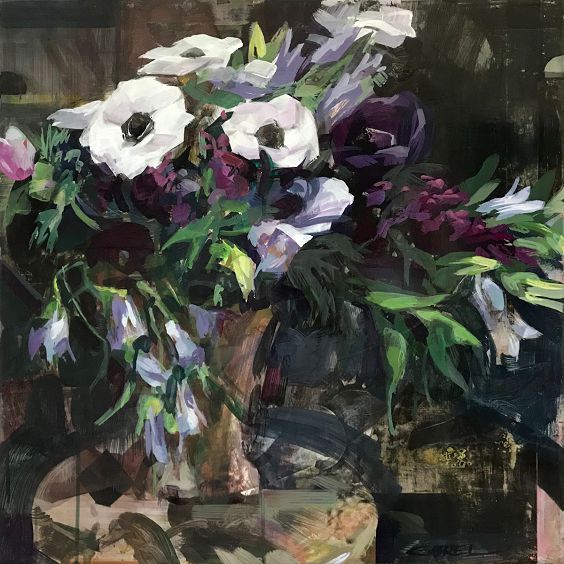
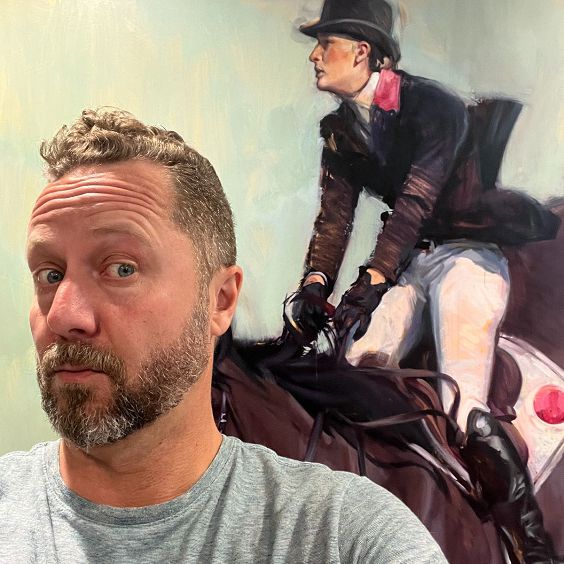
What color just feels like you? How does your favorite color show up in your work?

Are there any colors you never want to use? What color are you?

How Do You Water Your Creativity?

Have you ever waited at the bus stop of inspiration? It takes a long time.

“There are always flowers for those who want to see them.” – Henri Matisse

Sometimes inspiration is easy. I can be inspired by the impact of a word, the shape of a tree, or the characters in a myth or legend. There are other times when I find it more difficult to land an idea engaging enough to inspire a new painting let alone a whole new series.  Choosing any one idea can feel like a big commitment.

I could wait inspiration out, but I’ve found that the longer I stay in my head without grabbing my brushes, the more elusive the ideas become.  This conundrum can easily lead to melancholy and self-flagellation if I don’t nip it in the bud.  That’s when I call a professional.

Of course, I’m referring to the floral therapist. Laying on the “couch” can be pretty expensive these days so I have chosen self-care in the form of opulent bouquets instead.

Inspirations Fridays How do you Water Your Creativity

When I catch the smell of fresh flowers in the studio, I paint.

Have you ever treated yourself to a huge bouquet of flowers? Have you ever selfishly locked them up in your studio?  Cut flowers come with an urgency. They demand to be painted… and now. You have a window of a couple of days at best before the petals begin to fall and the entire bouquet shifts, wilts, and eventually asked to be laid to rest in the compost bin.

This urgency is important. I’m not talking about taking some snapshots of flowers from your community garden. I’m talking about stealing those flowers and engaging in the visceral race between beauty and time.  Painting the bouquet in front of you changes the way that you see the flowers themselves. Smell the perfume, notice the subtlety and richness of their colors, squint your eyes down and see the fullness of their forms. Cut flowers can be painted like a haiku.  Let them become shapes and colors. If you have some time left, include some of the details, but the details are not always necessary.

Now you’re painting. So furiously, in fact, that it might be a good night for pizza. You’ve got to get back in the studio, there is no time to waste.  It’s in this fervor that the seeds of inspiration are sown.  The muse descends and gives us a boost.  Engaging all of the senses changes the way you respond to the paint.  Each color comes with a smell, each line emulates the feel of a stem or a leaf.  Pizza tastes good.  Breath it in.

What little gifts inspire you into action? Have you given yourself the gift of inspiration lately?

What are your resistance workarounds and how do you water your creativity?

Run Naked into Battle!

Perfection is not only impossible… it’s boring.

“Conversation in real life is full of half-finished sentences and overlapping talk. Why shouldn’t painting be too?” – Edgar Degas

Dreams where I would show up to school with no pants on used to be a regular thing for me. I’m pretty sure there is some deep Jungian meaning here and I’ve probably already overshared, but that’s also how it felt for me to leave any part of my work unfinished. I used to try to hide every drawn line under the paint. The fact that I had to draw it in the first place was just another example of how difficult the whole process was for me. I didn’t want people to see my process or even imagine that I had one. I would be caught standing, knock-kneed in front of the class, with no pants on. The funny part of that dream was that no one ever noticed. All the kids would head out to the playground and I would remain, white-knuckled, knees under my desk, with no way to escape.

Inspiration Fridays Perfection is not only impossible... it's boring.

What preconceived notions about how your art is “supposed” to look are haunting your subconscious?

We can all get stuck in our heads. That fear of being discovered as a fraud, the need to justify what we do or somehow prove that we are worthy, is something that everyone has to tackle at some point on this journey. With that in mind, the beauty in this life is most luminous when we can share the story of how we overcome our obstacles. There is beauty in seeing the process. What if we painted holding space for the idea that at every stage, the painting could be done? The drawn image is beautiful on its own. Add some color… still beautiful. Lose the drawing, find it again, scrape it out, put it back.

It’s easy to become fixated on the results. The unfortunate casualty of result-oriented thinking is that there are often some extraordinarily beautiful moments along the way that we never have a chance to see.

This week while you are painting, experiment with the idea of removing yourself from the equation. See if you can’t look at your painting as if you have never seen it before and have no expectation for how it is supposed to look. Sometimes looking at a painting of yours in this way can be surprising. Sometimes the painting has already arrived and all that we need to do in order to see it is to remove the lens of who we think we are supposed to be.

Do you ever try to hide your process?

What is one way that you could make yourself more transparent in your work?

What if our failures were beautiful?