What if you have already arrived?

I can’t teach you how to paint like you, that’s for you to discover… but I can teach you how to keep moving forward.

“Life shrinks or expands in proportion to one’s courage.” – Anaïs Nin

I used to need a drink to paint. The creative process felt too big to conquer. Liquid courage. What if the painting I’m about to make isn’t worth doing? What will people think?

It’s tempting to let hesitation take over, and common to wonder if our ideas are good enough or if the work will measure up. But the real answer to that will only show up after our questions have been asked, and the work has been done.

Creativity thrives when we allow ourselves to explore. The first marks might feel tentative, but there’s more to come. As long as you are there for it. And this is the hard part. The part I felt that I needed to shore myself up against. The ugly middle. And with it, the doubt that I could ever arrive at something decent on the other side.

.
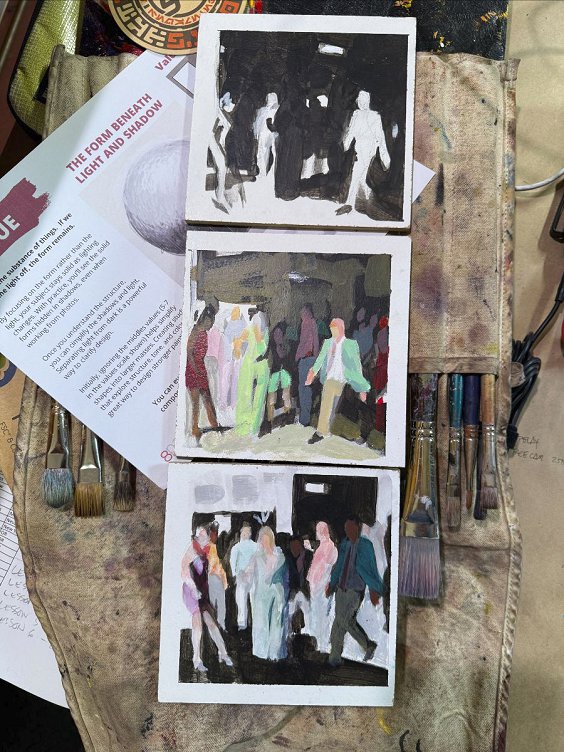
Inspiration Friday - What if you have already arrived?

Once we have the tools we need, we can be brave.

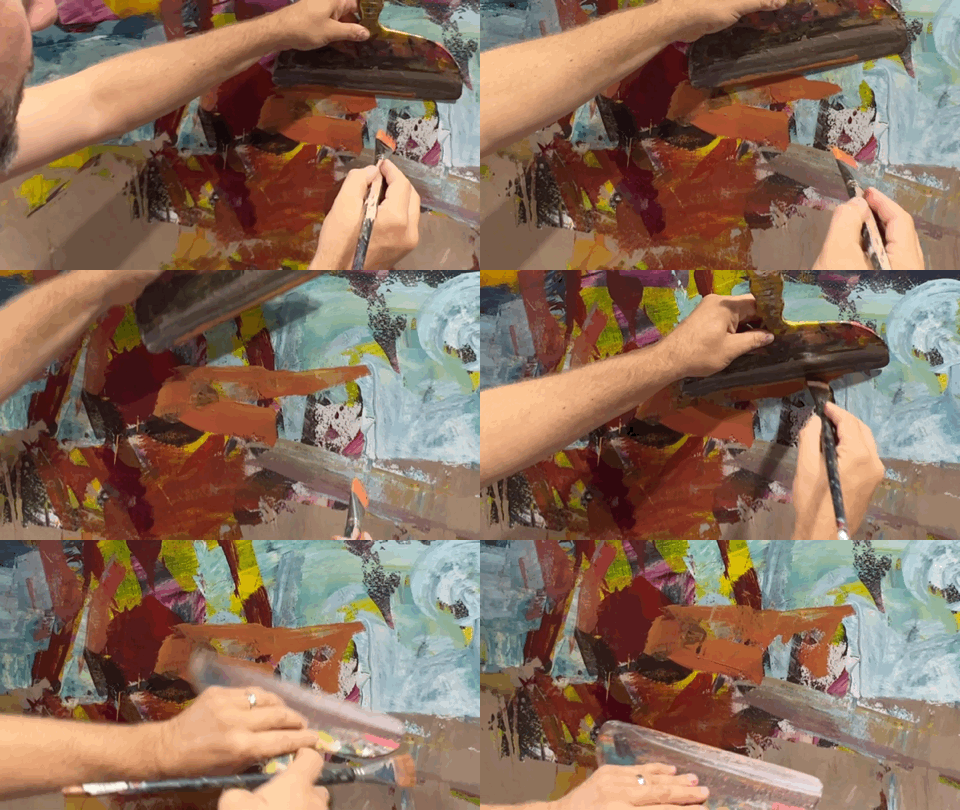
One swath of color leads to another, it’s not perfection, but we’ve made a start.

Courage in art doesn’t mean fearlessness. It means showing up despite the fear, making the effort, and trusting that your unique perspective matters. Every piece you create is fueled by the seeds of your ability, your connection to yourself, and an ever-expanding access to your imprint on the world.


What could happen if you approached your work with curiosity instead of judgment?

How would it feel to create for the joy of the process, rather than the outcome?

The next time you step into your creative space, bring your courage with you. Neat. Not for perfection, but for the freedom to explore.

What if you have already arrived?
 

What’s the best mistake you’ve ever made?

There’s a naïve confidence that’s fleeting. It can only exist when we have yet to discover how hard something actually is to do.

“My kid could do that.” – Anonymous

It’s the kind of confidence that might be found in a person passing by a bold, abstract by Franz Kline and seeing only a few brush strokes and a big price tag. They imagine it took five minutes and zero skill and don’t hesitate to say as much. A bit of paint splattered here, a color or two dragged there. Easy.

Maybe it was. For Franz.

.

Inspiration Friday - What's the best mistake you've ever made?

At the studio

Kids can dive in headfirst, trust their instincts, and believe they are enough. Their joy is unfiltered. They’ve yet to wrestle with the years of trial, error, and risk that help simplicity to land. But what looks simple is rarely so. That effortless stroke on the canvas? It’s born from the chaos of countless others that didn’t work.

I wish it were as easy as it can sometimes look. Yesterday I started off with spontaneous brush strokes only to watch helplessly as they devolved, suffocating under their own corrections. I packed up and went home.

My daughter was home too.  Smiling and drawing feverishly. Her shapes wobbled; her colors clashed. And it was perfect.

Watching her drawing reminded me of something I’d misplaced: the best art isn’t always about control. It’s about risk. It’s about playing with an idea, taking it too far, and being okay with what happens next. It’s about trusting that what you make, even when it gets overworked, or comes up short, is worth the effort.

So the next time someone thinks their kid could do it, maybe they can take it a step further and hand them a brush. See what happens. Maybe that kid will create something new and unexpected. Or maybe they’ll rediscover how much fun it is to try.


When was the last time you painted with no expectations?

Can you find the joy in trying?

What’s the best mistake you’ve ever made?


What Are You Aiming For??

The picture is only a part of the process.

“Do something, do something to that, and then do something to that.” – Jasper Johns

Right now my studio is riddled with paint filled squeeze tubes. A palimpsest of desaturated grays and brilliant hues lay on panels sandwiched between layers of clear acrylic gel medium. This method of piling it on, was probably inspired on some level by my discovery of Jasper Johns’ encaustic work. Johns is a master of material. Heaping layer upon layer to create depth, and build up visual history.

.

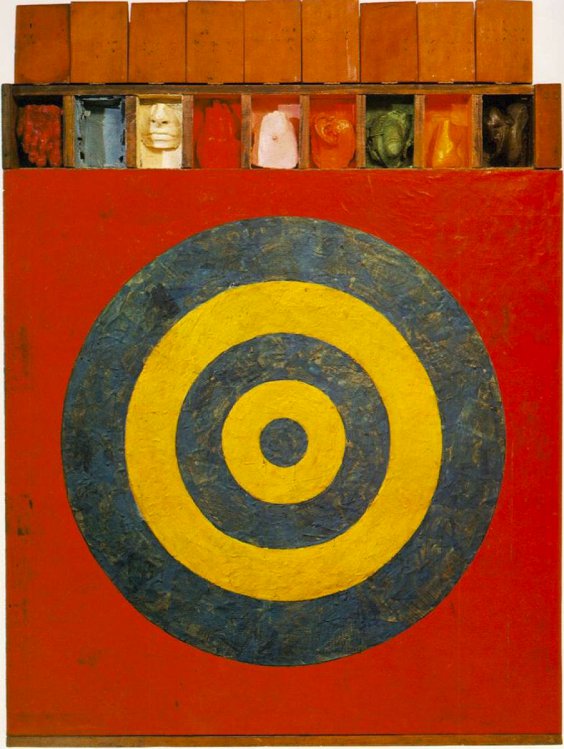
Jasper Johns - Target with Plaster Casts (1955) | 8paint Inspiration Friday

Jasper Johns – Target with Plaster Casts – 1955

I first met Jasper Johns’s Target with Plaster Casts face-to-face, in New York at the MOMA in 2001. Before that, it had only existed for me on the printed page of a stolen Library book. His encaustic mixture of pigment and hot wax, applied over scraps of newspaper, gave the flat shapes of the target texture and depth. I stood there, squinting, searching for hidden messages in the newsprint. “Return that book” it whispered.

The dualism of piece hits hard. Discarded precision. Every layer feels both deliberate and accidental. As Johns himself said, “I tend to like things that the mind already knows.”

His approach feels particularly resonant in this digital age of regurgitated imagery and AI prompts. It asks us to slow down, to consider texture, process, and context. Each element, whether it’s a brushstroke, a color choice, even the plaster cast of an ear or nipple, is tangible and human.

Born in Augusta, Georgia, in 1930, and raised in the rural South, Jasper Johns described his childhood as isolated and without much exposure to art. Maybe that’s why his work feels so accessible to me. I didn’t know that the artworld existed until halfway through high school, and even then, I was still living in Oregon.


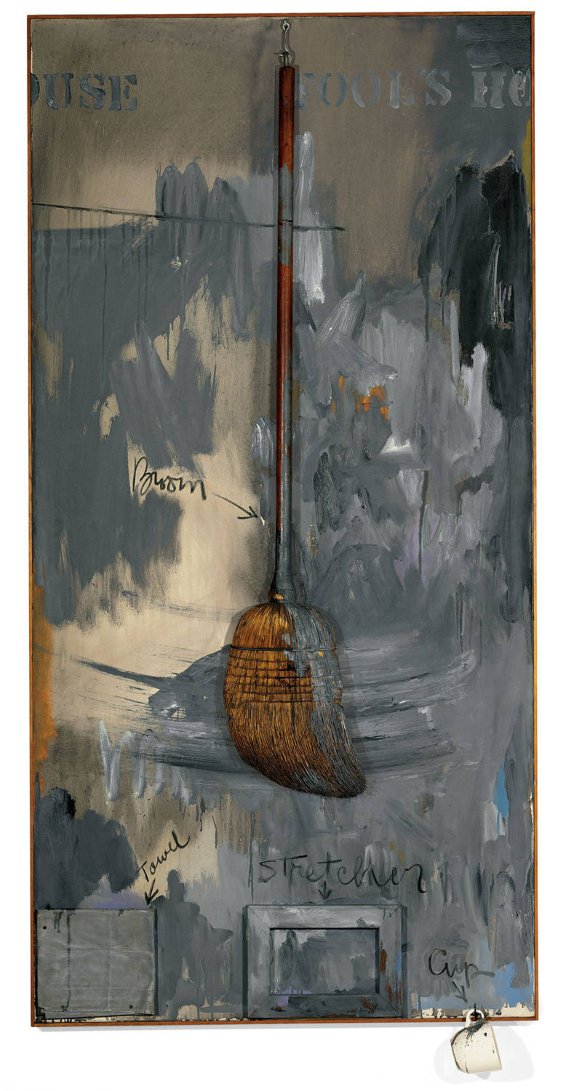
Jasper Johns - Fool's House (1964) | 8paint Inspiration Friday

Jasper Johns – Fool’s House – 1964


Johns uses symbols and objects to play with our perception, and interpretation of the world around us. What’s strikes me most when I stand in front of his work, is how he allows the materials themselves to speak. Wax hardens unpredictably, and newsprint lives just under the paint’s surface, like unearthed petroglyphs. There’s a real broom dangling from a hook in the middle of a canvas. I think he used it to sweep away hesitation and self-doubt.

In the studio, it’s tempting to chase perfection, to try to erase the moments when our tools misbehave or the drawing goes wrong. But there’s something incredibly honest in letting our process show through. It’s brave to allow ourselves to be seen.

Are there layers in your own work, histories or insights into your struggle, that you’ve been tempted to obscure? What would happen if you let them breathe? What story would your layers tell?


What happens when you embrace ambiguity over clarity?

What happens when precision meets imperfection?

What Are You Aiming For?


Sign up below to receive the FREE Artist’s Tool Kit and start exploring the foundations of your creative journey. Thank you for being part of this artistic community.
You inspire me daily.

Paint tuff!

Gabriel Lipper


The Artist's Toolkit - Free Download!